Tree and Binary Tree 樹與二元樹
🐳 Tree 樹
🦀 定義
- 由至少一個 node 組成,不得為空。
- 至少有一個特定 node 稱為 root。
- 其餘 nodes 分為 T1 ~ Tm 個集合,稱為 subtree of root。
以下圖的 tree 為例說明用來描述 tree 的名詞:
- node's degree:一個 node 擁有的 subtree(子樹)的個數。例如:A 的 degree 是 3,D 的 degree 是 2,J 的 degree 是 0。
- root:樹中最上層的 node,也是唯一一個 parent 為 null 的 node。例如:A 是這個 tree 的 root。
- leaf:沒有 child/subtree 的 node 稱為 leaf。例如:E、F、G、H、I、J 都是 leaf。
- non-leaf:不是 leaf 的 node 稱為 non-leaf。例如:A、B、C、D 都是 non-leaf。
- parent and child:以箭頭的指向來區分,被指向者為 child,指向者為 parent,例如:A 是 BCD 的 parent,BCD 是 A 的 children。
- sibling:擁有相同 parent 的 node 們,互相稱為 sibling,例如:A 是 BCD 的 parent,所以 BCD 是 siblings。
- ancestors:如圖中,以 F 的角度觀察,所有能夠以「指向 parent」的方式找到的 node,都稱為 F 的 ancestors,因此 AB 為 F 的 ancestors。
- descendants:如圖中,以 A 的角度觀察,所有能夠以「parent 指向 child」的方式找到的 node,都稱為 A 的 descendant,因此整棵樹除了 A 以外皆為 A 的 descendant,以此類推。
- node's level:root 的 level 為 0 或 1,其他 node 的 level 為其 parent 的 level 加一。
- height:樹的高度,也就是 node's level 取最大值。
- tree's degree:所有 node's degree 取最大值。
- forest:由 tree 所形成的集合,可以為空。
🦀 Representations 樹的表示方法
use linked list to represent tree directly
用 linked list 來表示 tree,假設 tree′s degree=k,node 的 structure 可以設計成:
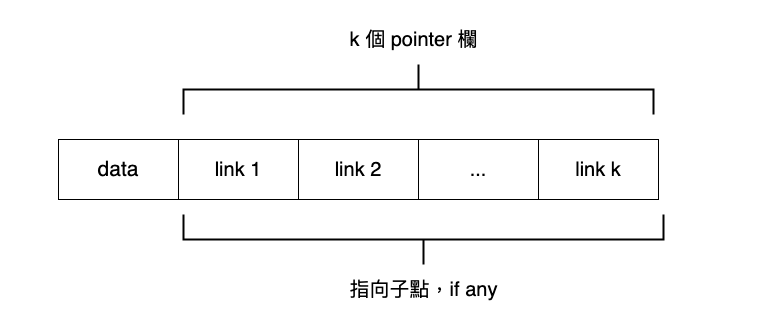
以上面的 node structure 來表示下圖的 tree:
tree′s degree=3
會變成:
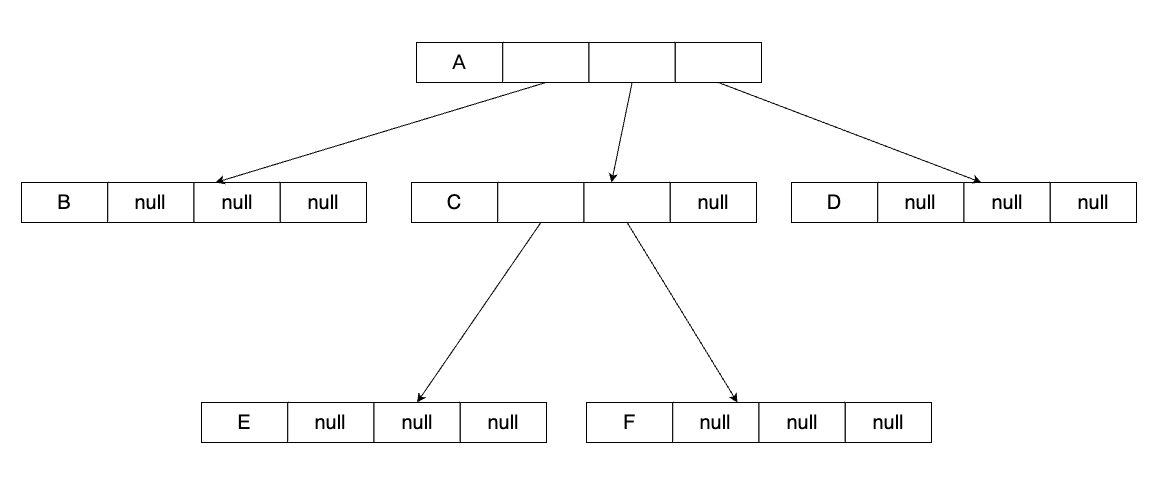
假設 tree 有 n 個 node,tree′s degree=k∴會需要準備 n∗k 條 links,其中只有 n−1 條 links 非 null。∴null link=nk−(n−1) 條∴浪費比例=nknk−(n−1),只有在 n=2 的時候浪費比例最少。 child-sibling
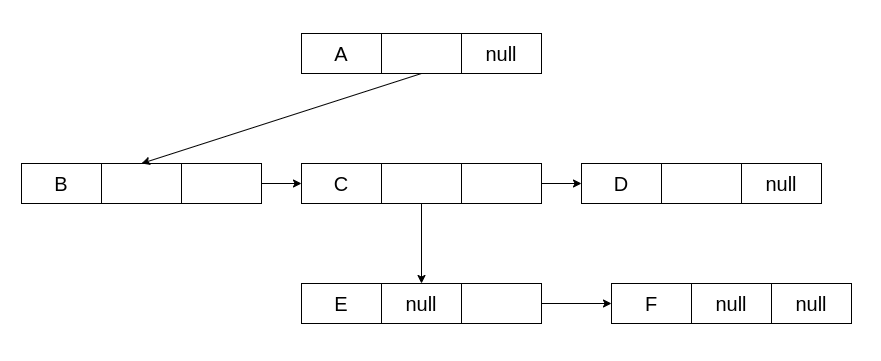
還是用 linked list 來表示 tree,但是換一個角度來重新設計 node structure,來解決前一個方法浪費記憶體空間的問題。
來重新設計 node structure 成如下圖的結構:

- child:pointer,指向 「left-most」 child
- sibling:pointer,指向 node 右邊的 sibling
現在以上面重新設計的 node structure 來表示下圖的 tree:
tree′s degree=3
會變成:
括號法
用 父點(子點...子點) 表示父與子點之間的組成關係,可以巢狀表示。
舉個例子,以括號法來表示下圖的 tree:
可以寫成:A(B(EF)C(G)D(HIJ))
🐳 Binary Tree 二元樹
🦀 定義
由至少一個 node 組成,可以為空,若不為空,則滿足:
- 有 root 及左右子樹
- 左右子樹也是 binary tree
🦀 Binary Tree 的三個定理
假設:root level = 1,【定理一】:
The ith level in a binary tree has at most 2i−1 nodes
證明:用數學歸納法
假設:root level = 1,【定理二】:
The binary tree with height H, has at most 2H−1 nodes, at least H nodes.
證明:
(1)最多nodes,也就是每個節點長好長滿:節點數=20+21+...+2H−1=1−21∗(1−2H)=2H−1(2)最少nodes,也就是每個level只有一個節點,所以節點數=H
假設:root level = 1,【定理三】:
For a non−empty binary tree, if there are n0 leaves and n2 degree−2 nodes, then n0 = n2 + 1
證明:
令n:node總數n0: degree−0 之 node 數\(即leaves數)n1: degree−1 之 node 數n2: degree−2 之 node 數B: branch(分支)總數則 {n=n0+n1+n2=B+1 (1)B=1∗n1+2∗n2 (2)將 (2) 式代入 (1) 式得:n0+n1+n2=1n1+2n2+1⟺n0=n2+1
🦀 Binary Tree 的種類
| 種類 | 定義 |
|---|
| Skewed Binary Tree | - Left-skewed Binary Tree: each non-leaf node has left-child only, without right child.
- Right-skewed Binary Tree: each non-leaf node has right-child only, without left child.
- 如果有 n 個節點,則樹高為 n。(if root level = 1)
|
| Full Binary Tree | - 具有最多節點的 Binary Tree
- if the height is h, and root level is 1, then Full Binary Tree has 2h−1 nodes.
|
| Complete Binary Tree | - 節點增長順序:由上而下,同一 level 由左而右。
- 如果高度為 h,則節點數大於 2h−1−1,小於等於 2h−1。
|
| Strict Binary Tree | - Each non-leaf node will have two children. There is no degree-1 nodes exist.
|
🦀 Binary Tree Representations
有兩種表示二元樹的方法,分別是用 array 或是 linked list。下面表格是針對這兩種方式的優缺點比較:
| Array | Linked List |
|---|
| 優點 | - 容易存取左右子點與父點
- 對於 full/complete binary tree 可以充分利用記憶體空間,沒有浪費
| - 容易增刪節點
- 如果是 skewed binary tree,用 linked list 會比用 array 節省記憶體空間
|
| 缺點 | - 不容易增刪節點
- 如果是 skewed binary tree,用 array 來表示非常浪費記憶體空間。若高度為 H,浪費的格數為 2H−1−H
| - 不容易存取父節點
- 可以參考 這邊
|
🐳 Resource